Aug 27, 2026Technical Guides
Temperature and Humidity Monitoring for Industrial Environments
Industrial temperature and humidity monitoring depends on representative sensor placement, suitable installation, environmental exposure and a defined verification plan.
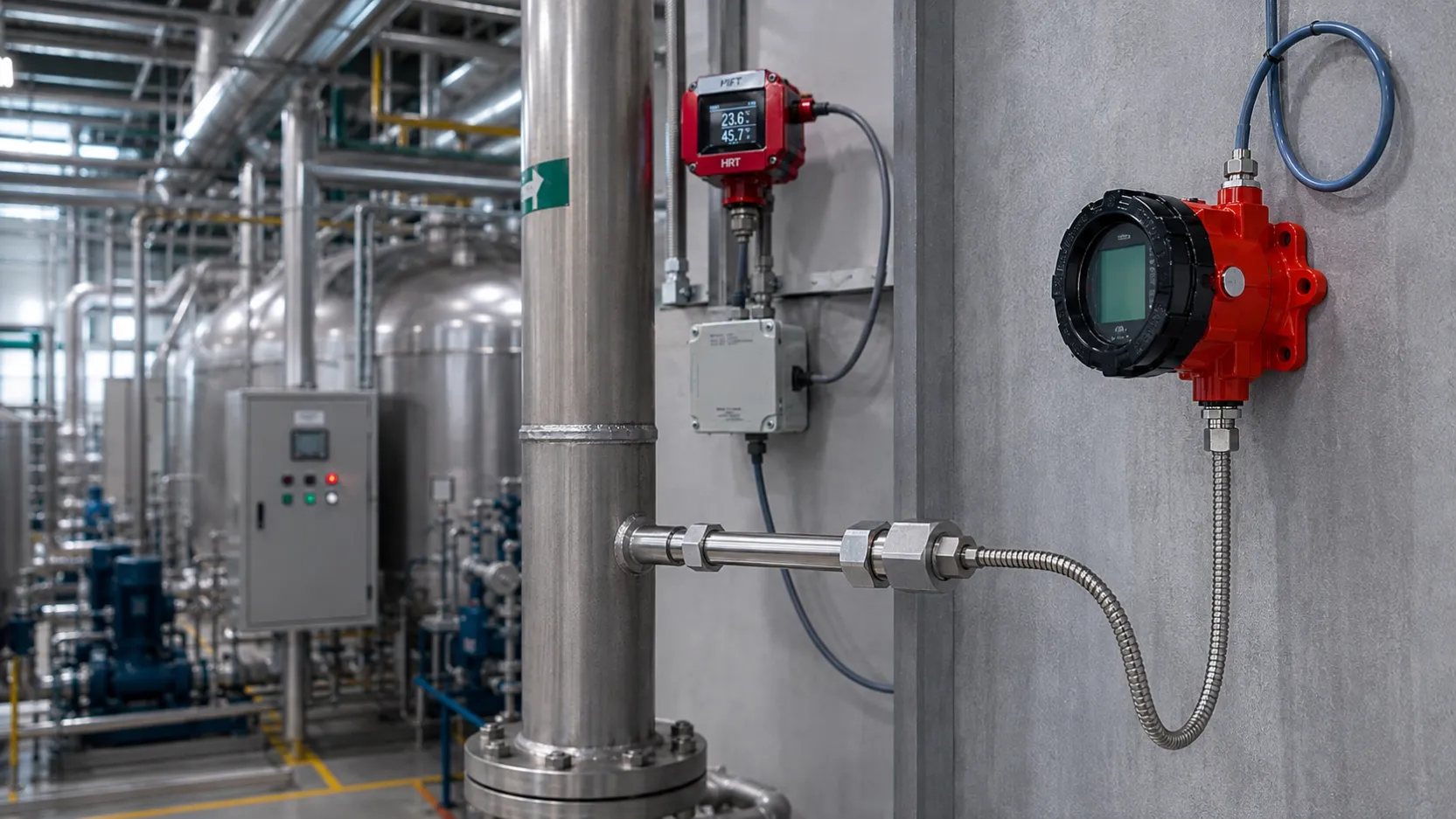
Temperature and humidity monitoring is most useful when it represents the actual environmental condition that operators need to understand or control. Sensor placement, response, exposure, installation and verification can matter as much as the transmitter specification itself.
Why both variables matter
Temperature and relative humidity should normally be interpreted together because relative humidity changes with temperature. For industrial monitoring, the more practical question is whether the selected measurement point represents the condition that affects the process, material or equipment.
For the broader relationship between temperature, humidity, measurement location and sensor selection, see Temperature and Humidity Measurement in Industrial and Controlled Environments: Principles, Applications and Selection.
Typical applications
Environmental measurements can support:
- HVAC and ventilation control;
- storage and warehouse condition monitoring;
- clean or controlled production areas;
- electrical rooms and equipment enclosures;
- drying, curing or conditioning processes;
- building and facility monitoring.
Application requirements vary. A comfort-monitoring point, a storage alarm and a production-control loop may need different response, accuracy, placement and calibration practices.
Select the measurement point
Choose a position that represents the area or process being controlled. Avoid unintended influence from direct sunlight, heaters, cold surfaces, supply-air jets, doors or stagnant pockets unless those local conditions are the measurement target.
For ducts, chambers or equipment, review insertion depth, airflow, thermal conduction, sealing and access for inspection. A remote or split probe may help separate the sensing location from the transmitter electronics, but the exact configuration should be confirmed for the installation.
Review condensation and dew point
Condensation can occur when a surface is colder than the local dew-point temperature. Monitoring temperature and humidity can support condensation assessment, but the sensor reading must represent the relevant location. Surface temperature, airflow and thermal bridges may still require separate evaluation.
Compressed-air applications may require a dedicated dew-point instrument rather than a general room humidity transmitter. The required measurement range and pressure conditions should be defined before selection.
Choose the instrument
Confirm:
- temperature and humidity ranges;
- required uncertainty and response;
- ambient and process exposure;
- probe or enclosure configuration;
- condensation, dust or washdown risk;
- output signal and power supply;
- display or remote-access needs;
- mounting and cable arrangement;
- calibration and replacement plan.
Do not infer hazardous-area approval, ingress protection, communication or environmental limits from a product-family name. Verify these attributes for the exact model and configuration.
Installation and commissioning
Mount the sensor according to its intended orientation and exposure. Protect cable entries, avoid uncontrolled heat conduction and confirm that ventilation around the sensing element matches the application. Check engineering units, scaling, output and alarm logic in the receiving system.
At commissioning, compare the reading with a suitable reference under stable conditions and document the installed location. Differences between nearby sensors may reflect real environmental gradients rather than a sensor fault.
Maintenance and verification
Contamination, condensation, aging and physical damage can affect measurement. Establish an inspection and verification interval based on process criticality and exposure. Clean or replace sensing elements only according to the model documentation.
Trend data can help identify gradual change, but it does not replace periodic verification. When a reading changes, check the environment, placement, wiring, control-system scaling and reference method before concluding that the sensor has drifted.
Practical questions
Is one sensor enough for a large room?
Not always. Room size, airflow, heat sources, doors and equipment can create gradients. Use a placement study or multiple points when the controlled space is not uniform.
Can temperature compensation remove every environmental error?
No. Compensation may address specified sensor behavior, but placement, condensation, response time, wiring and process conditions still affect the final measurement.
Does low humidity always create an electrostatic-discharge problem?
Risk depends on materials, processes, grounding, handling and the actual environment. Humidity is one factor and should be assessed within the facility’s ESD-control plan.
How should alarm limits be chosen?
Use process, material, equipment or quality requirements that apply to the specific site. Do not copy limits from an unrelated application.
Next step
Before selecting an industrial temperature and humidity monitoring arrangement, prepare the expected temperature and humidity range, measurement location, airflow conditions, possible condensation or contamination, required output, installation method and verification requirements.
HRT can review available configurations against the actual monitoring point and system interface. Final suitability should be confirmed for the selected product, configuration and operating conditions.