Aug 26, 2026Technical Guides
Temperature and Humidity Measurement in Industrial and Controlled Environments: Principles, Applications and Selection
Learn how temperature and humidity affect industrial and controlled environments, why measurement location matters, and what to confirm before selecting a monitoring arrangement.
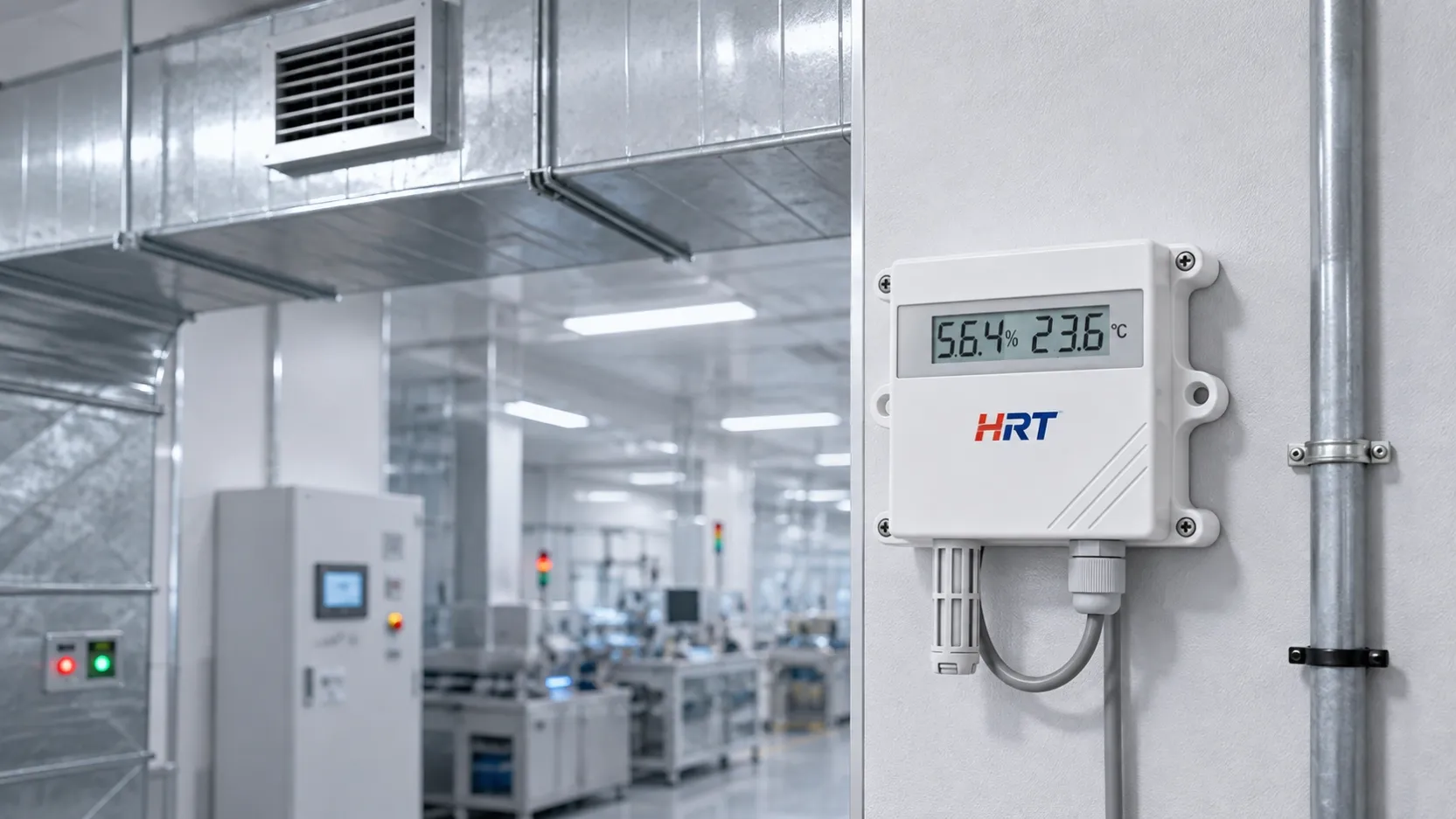
Temperature and humidity measurements become useful when they help answer a defined process, storage or environmental question.
Is a production area staying within an agreed operating condition? Is material being stored in a suitable environment? Is condensation becoming possible? Did an HVAC adjustment produce the expected result? Is a change in the environment related to a process or equipment problem?
The value of monitoring therefore does not come from the sensor alone.
A useful measurement depends on what needs to be understood, where the condition should be measured, how quickly it changes, which variable is relevant and how the resulting data will be used.
What should temperature and humidity measurement tell you?
Temperature and humidity measurements can support different operational decisions.
Typical tasks include:
• monitoring production or storage environments;
• supporting HVAC and ventilation control;
• identifying environmental changes associated with a process event;
• monitoring drying, curing or conditioning processes;
• reducing uncertainty around condensation conditions;
• supporting clean or controlled environments;
• documenting conditions during storage, production or testing;
• triggering an approved alarm or inspection response;
• monitoring remote or difficult-to-access locations.
The measurement task should be defined before the instrument is selected.
A room sensor, duct probe, surface sensor and immersed temperature probe may all measure temperature, but they do not describe the same physical condition.
Temperature is not just a room value
Temperature affects heat transfer, reaction rates, phase changes, material expansion and many physical, chemical and biological processes.
In industrial applications, temperature may influence:
• drying;
• curing;
• mixing;
• reaction behaviour;
• storage stability;
• material dimensions;
• equipment operation;
• the response of other measurement devices.
A temperature value only becomes useful when the measurement location and measurement method correspond to the actual question.
Ambient air temperature cannot automatically describe the temperature inside a material.
A surface measurement cannot automatically replace an immersed measurement.
A slowly changing warehouse environment may not require the same sensor response as a rapidly changing process stream.
The correct measurement arrangement therefore depends on what temperature needs to be represented.
Why humidity needs temperature context
Relative humidity describes the amount of water vapour in air relative to the amount the air could contain at the same temperature.
Because this relationship changes with temperature, relative humidity should not normally be interpreted without temperature context.
If air cools while its moisture content remains similar, relative humidity can rise and the condition may move closer to condensation.
This relationship is important in:
• HVAC systems;
• warehouses;
• electronics production;
• drying processes;
• clean or controlled rooms;
• environmental monitoring;
• applications where condensation needs to be avoided.
Depending on the process question, relative humidity may not always be the most useful moisture variable.
Dew point, absolute humidity or another moisture-related quantity may provide better information in some applications.
The selected variable should follow the process decision rather than simply the easiest value to display.
Where temperature and humidity measurement is used
Production environments
Environmental conditions can affect materials, equipment and process behaviour.
Monitoring can help show whether the production environment remained within a defined operating condition and whether an environmental change occurred before or after a process event.
The measurement does not automatically identify the cause of a process problem. Material condition, machine operation, airflow, operator actions and other variables may also need to be reviewed.
Storage and warehousing
Temperature and humidity measurements can help document the environment in which materials, components or finished products are stored.
The useful measurement point should represent the stored material rather than simply the most convenient wall or air outlet.
Large warehouses can contain temperature gradients, airflow differences and localised environmental zones.
A single sensor should not automatically be assumed to represent the complete storage area.
HVAC and ventilation systems
Temperature and humidity data can support HVAC adjustment and help compare conditions before and after a control change.
Sensor placement is especially important.
A point close to a supply-air outlet, heating coil, cooling coil, door, window or leakage path may describe a local condition rather than the entire occupied or controlled space.
Duct measurements also require representative airflow and appropriate probe exposure.
Clean and controlled environments
Some processes require defined environmental conditions for production, handling, testing or storage.
The measurement arrangement should match the applicable operating procedure and quality requirements.
Monitoring does not by itself prove product quality.
It provides evidence about selected environmental variables within the measurement system that has been defined and verified.
Drying and conditioning processes
Temperature and humidity can influence drying and conditioning behaviour.
Changes in air temperature, moisture content and airflow can affect how quickly moisture is removed or redistributed.
The appropriate monitoring arrangement should therefore consider the process stage, air movement, material location and required response time.
What can make temperature and humidity data misleading?
A high-quality sensor can still produce data that does not represent the actual process condition.
Important causes include:
• poor sensor location;
• direct heating or cooling from nearby equipment;
• sunlight or thermal radiation;
• insufficient airflow;
• excessive airflow;
• temperature gradients;
• condensation on the sensing element;
• dust or chemical contamination;
• unsuitable protective filters;
• slow response compared with the process;
• incorrect insertion depth;
• wiring or scaling errors;
• sensor drift;
• inadequate calibration or verification.
A stable reading does not automatically mean that the measurement is correct.
The complete measurement arrangement should be considered.
Measurement location is part of the instrument selection
One of the most important questions is:
Where should the condition be measured?
The answer depends on what the value is expected to represent.
Possible locations include:
• ambient room air;
• inside a duct;
• near stored material;
• inside an enclosure;
• on a surface;
• inside a process medium;
• upstream or downstream of HVAC equipment;
• a remote outdoor point.
The sensing location and transmitter location do not always need to be the same.
A separated probe arrangement can be useful where the sensing point needs to be placed in a duct, chamber or process location while the transmitter remains accessible for wiring, display or maintenance.
The installation should provide representative exposure while allowing inspection and service.
Response time matters
Environmental conditions do not always change at the same speed.
A slowly changing warehouse may tolerate a longer response time.
A duct, drying process or rapidly changing controlled environment may require faster response.
The complete response includes more than the sensing element itself.
Protective filters, probe housings, airflow, mounting structures and installation depth can all influence how quickly the measurement responds to a real environmental change.
For this reason, response time should be considered as part of the installed measurement system.
Condensation deserves separate attention
Condensation can affect both the process and the measurement device.
A relative-humidity value approaching saturation may indicate increasing condensation potential, but the actual surface temperature also matters.
A sensor exposed directly to condensation may respond differently from one operating within its intended environmental range.
Where condensation is possible, review:
• operating temperature;
• humidity range;
• surface temperature;
• sensor protection;
• installation position;
• recovery after condensation;
• maintenance requirements.
Do not assume that a sensor rated for high relative humidity can automatically operate correctly under continuous condensation.
Select the output around the complete monitoring system
The measurement signal must integrate with the receiving system.
Before selecting an interface, confirm:
• available power supply;
• required output;
• wiring distance;
• electrical noise;
• PLC or controller input;
• engineering units;
• scaling;
• local display requirements;
• communication requirements;
• remote monitoring requirements;
• expected update interval;
• fault or alarm behaviour.
A digital or wireless output is not automatically better than an analog output.
The correct interface depends on the installation, receiving system and required monitoring function.
Wireless and remote monitoring
Wireless or connected monitoring can make remote points easier to observe and can support trend recording across multiple locations.
However, communication does not improve the quality of the underlying measurement by itself.
A remote system should also consider:
• power source;
• communication coverage;
• update interval;
• data continuity;
• network availability;
• cybersecurity;
• maintenance access.
A remote dashboard can display an incorrect environmental value very efficiently if the sensing point, scaling or calibration is wrong.
The measurement should therefore be validated before it becomes the basis for operational decisions.
Calibration and verification
Temperature and humidity sensors can change over time because of ageing, contamination and environmental exposure.
There is no single verification interval that is correct for every application.
The interval should reflect:
• required measurement uncertainty;
• process importance;
• environmental severity;
• contamination risk;
• historical sensor performance;
• site quality procedures;
• applicable regulatory or customer requirements.
At commissioning, confirm:
• installed sensor and probe type;
• measurement location;
• temperature and humidity range;
• output;
• engineering units;
• control-system scaling;
• alarm or trend behaviour;
• baseline readings.
A reference check or calibration plan should be defined when the measurement will be used as evidence for process, storage or quality decisions.
How to select a temperature and humidity measurement arrangement
A practical selection process starts with the measurement question rather than with a transmitter model.
1.Define what needs to be measured
Determine whether the target is:
• ambient air;
• duct air;
• process air;
• a surface;
• material temperature;
• a process medium;
• another defined measurement point.
2.Define why the measurement is needed
Clarify whether the data will support:
• environmental monitoring;
• HVAC control;
• storage records;
• process adjustment;
• drying or conditioning;
• alarm functions;
• maintenance;
• troubleshooting;
• remote monitoring.
3.Define the operating range
Confirm:
• normal temperature;
• minimum and maximum temperature;
• normal humidity range;
• abnormal environmental conditions;
• possible condensation;
• required response time.
4.Review the measurement environment
Consider:
• airflow;
• temperature gradients;
• dust;
• chemicals;
• direct radiation;
• cleaning;
• vibration;
• outdoor exposure;
• condensation;
• installation access.
5.Choose the sensing arrangement
Determine whether the application requires:
• integrated transmitter and sensor;
• separated probe;
• duct probe;
• wall-mounted sensor;
• insertion probe;
• remote sensing location;
• another application-specific arrangement.
6.Confirm output and integration
Verify the required:
• power;
• output;
• wiring;
• communication;
• display;
• remote monitoring;
• system compatibility.
7.Plan commissioning and verification
Define how the measurement location, scaling, response and reference values will be checked before the data is trusted.
Practical questions
Why measure temperature and humidity together?
Temperature affects relative humidity, so both values provide a more complete description of environmental conditions than either value alone.
Where should a temperature and humidity sensor be installed?
The sensing point should represent the environment or process condition being monitored.
Avoid selecting the installation position only because it is easy to access.
Does continuous monitoring prove product quality?
No.
Monitoring provides evidence about selected environmental variables.
Product quality also depends on materials, equipment, procedures, process conditions and other quality controls.
How often should a temperature and humidity sensor be checked?
There is no universal interval.
The verification or calibration plan should reflect measurement importance, environmental exposure, required uncertainty and historical performance.
Can wireless monitoring replace good sensor placement?
No.
Wireless communication changes how data is transferred, not whether the sensing point represents the process correctly.
Next step
A useful temperature and humidity measurement starts with the actual monitoring question.
Define:
what needs to be measured → where the condition should be measured → what operating range is expected → how quickly the condition can change → what environmental exposure affects the sensor → how the signal will be transmitted → how the measurement will be verified.
For applications where the sensing point and transmitter location need to differ, a separated temperature and humidity measurement arrangement can be reviewed.
For wall-mounted, duct, outdoor, remote or other industrial monitoring applications, the sensing arrangement, output, enclosure and environmental suitability should be confirmed against the actual installation.
Final suitability should be confirmed for the selected product, configuration and operating conditions.