Sep 3, 2026
Hydrostatic Level Measurement: How Pressure Becomes Liquid Level
Learn how hydrostatic level measurement converts liquid-column pressure into level, how installation and density affect the result, and what to verify before selection.
Level does not always have to be measured from above the liquid surface.
In many applications, liquid level can be determined from the pressure created by the liquid column itself. This is the basis of hydrostatic level measurement.
The principle is straightforward, but a reliable level value depends on more than installing a pressure sensor at the bottom of a tank or lowering a probe into the liquid.
Liquid density, pressure reference, sensing position, vessel pressure, installation arrangement and signal scaling all affect how measured pressure becomes a useful level value.
Understanding these relationships helps determine when hydrostatic measurement is appropriate and what needs to be confirmed before selecting and installing an instrument.
The relationship between pressure and liquid level
For a static liquid column, the hydrostatic pressure produced by the liquid can be described conceptually as:
P = ρgh
where:
- P = hydrostatic pressure;
- ρ = liquid density;
- g = gravitational acceleration;
- h = height of liquid above the pressure-sensing point.
This relationship explains why pressure can be used to determine liquid level.
If liquid density is known and sufficiently stable, the pressure measured at a defined point can be converted into the height of liquid above that point.
But the pressure sensor does not directly “see” the tank level.
It measures pressure.
The level value is obtained only after that pressure is interpreted using the correct density, pressure reference and installation geometry.
That distinction is important when configuring transmitters, PLCs, DCS systems, local displays or remote monitoring platforms.
What does the pressure transmitter actually measure?
Consider a pressure measurement point near the bottom of a liquid-filled tank.
As the liquid level rises, the height of liquid above the sensing point increases. The resulting hydrostatic pressure also increases.
As the level falls, the hydrostatic pressure decreases.
The pressure signal can therefore be used as an indication of level.
However, the measurement reference begins at the pressure-sensing point, not automatically at the physical bottom of the vessel.
If the process connection is located above the tank bottom, the instrument measures the liquid column above that connection.
Similarly, if a submersible probe is suspended above the lowest point of a tank, well or sump, its pressure measurement corresponds to the liquid column above the probe's sensing position.
Installation geometry must therefore be included when converting pressure into the level value required by the process.
Two common hydrostatic measurement arrangements
Hydrostatic level measurement can be implemented using different mechanical arrangements.
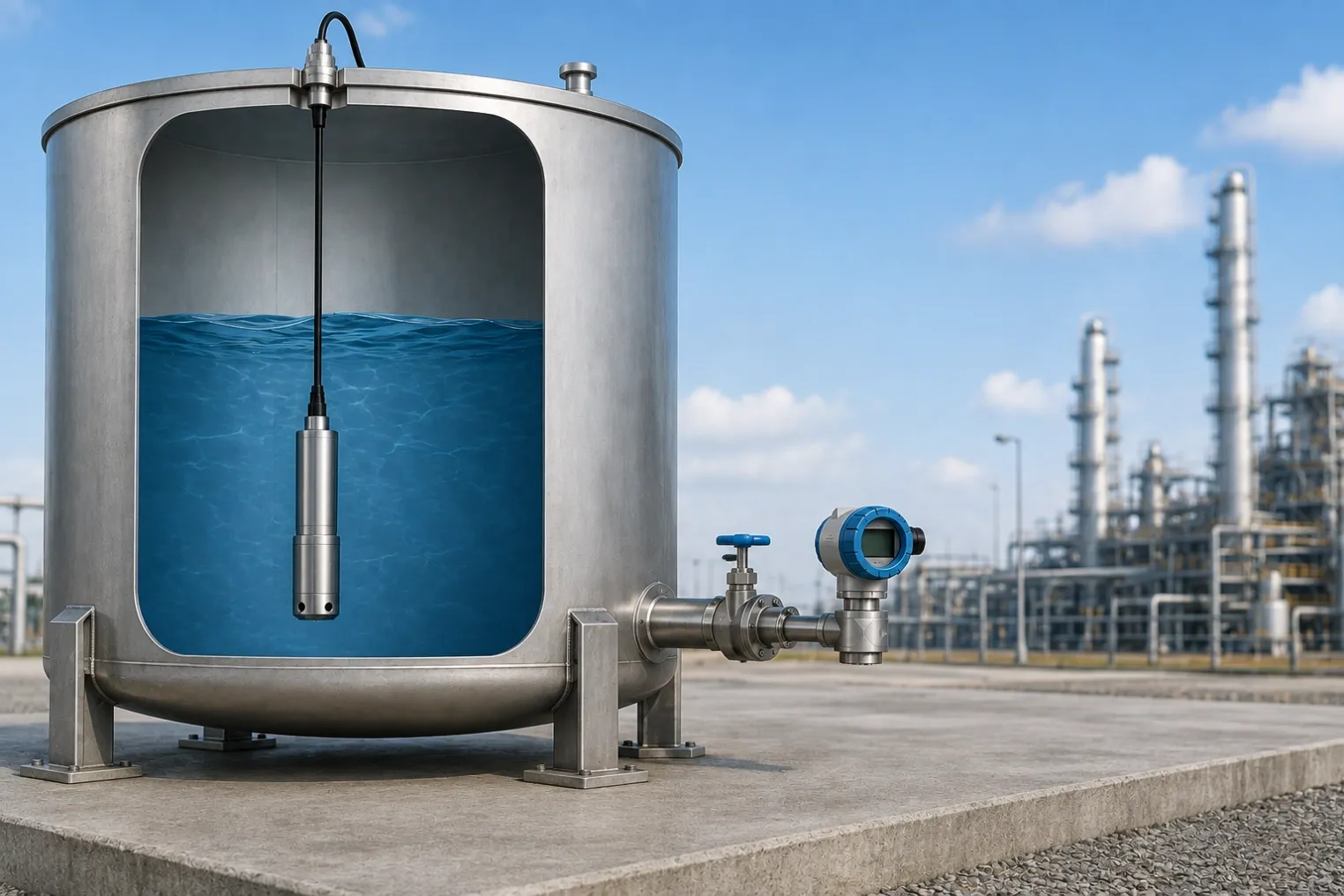
Two common approaches are a submersible pressure probe and an externally mounted pressure transmitter connected near the lower part of the vessel.
Submersible measurement
A submersible level transmitter or pressure probe is lowered directly into the liquid.
The sensing element measures the pressure produced by the liquid column above its sensing position.
This arrangement can be practical where installing a process connection near the bottom of the vessel is inconvenient, or where the measurement point is located in a well, sump, water tank or similar structure.
The installation should consider:
- probe position;
- cable length and support;
- pressure reference or venting arrangement;
- cable protection;
- liquid compatibility;
- sediment or deposits;
- possible movement of the probe;
- access for inspection or removal.
The cable is therefore part of the installation arrangement, not simply an electrical connection.
Bottom- or lower-side-mounted pressure measurement
Hydrostatic level can also be determined using a pressure transmitter installed through a suitable process connection near the bottom or lower side of a vessel.
The transmitter may use a threaded or other suitable process connection according to the vessel and installation design.
In this arrangement, the vessel requires an appropriate pressure connection.
The transmitter measures pressure at the installation point, and the resulting signal can be converted into liquid level when the liquid density, pressure reference and installation height are correctly defined.
This arrangement can be useful where the vessel already provides a suitable pressure connection or where external access to the transmitter is preferred for installation, inspection or maintenance.
The pressure connection itself must also remain representative of the actual vessel pressure. Blockage, deposits, trapped material or an unsuitable connection position can affect the measurement.
Why liquid density matters
Hydrostatic level measurement depends directly on liquid density.
From:
P = ρgh
the same liquid height can produce different pressures if density changes.
This means that a pressure transmitter can be measuring pressure correctly while the calculated level is still wrong.
For example, if the control system converts pressure to level using one fixed density value but the actual liquid density changes with composition, concentration or temperature, the calculated height can shift even when the real liquid level has not changed.
The practical question is therefore not only:
What is the liquid?
It is also:
How stable is its density under actual operating conditions?
For applications where density varies significantly, the expected variation and required level-measurement performance should be reviewed before a fixed pressure-to-level conversion is used.
Open tanks and pressure reference
Pressure reference is another fundamental part of hydrostatic level measurement.
In an open or properly vented tank, the liquid surface is exposed to atmospheric pressure.
If the pressure measurement is referenced to the same atmosphere, the measured pressure at the lower sensing point can represent the pressure produced by the liquid column.
Conceptually, atmospheric pressure acts on both sides of the measurement reference and the remaining measured pressure corresponds to the hydrostatic contribution.
This is why gauge-pressure measurement is commonly associated with hydrostatic level measurement in open or vented vessels.
But the reference must actually remain valid.
For a submersible transmitter using a vented reference arrangement, the condition of the vent path can influence the measurement.
Moisture, blockage, installation practice or other problems affecting the reference path can introduce an apparent pressure change that may then be interpreted incorrectly as a level change.
The pressure reference is therefore part of the complete measurement system.
Closed and pressurized vessels are different
A closed vessel may contain gas or vapour pressure above the liquid surface.
In this case, the pressure measured near the bottom of the vessel is not necessarily produced by liquid height alone.
Conceptually:
Pbottom = Pgas + ρgh
where the bottom pressure contains both:
- pressure acting above the liquid surface; and
- hydrostatic pressure produced by the liquid column.
This creates an important measurement problem.
If the gas-space pressure increases while the actual liquid level remains unchanged, a single pressure transmitter at the bottom can indicate a higher pressure.
If that pressure is interpreted directly as additional liquid height, the calculated level will be wrong.
For pressurized vessels, the measurement arrangement may therefore need to account for both the pressure at the lower measurement point and the pressure above the liquid surface.
Differential-pressure measurement is one established method for doing this in suitable applications.
This is also where pressure measurement and level measurement directly intersect: the instrument may measure pressure, but the required process variable is level, and the correct result depends on understanding which pressures are included in the measurement.
For a broader explanation of gauge, absolute and differential pressure references, see Gauge vs. Absolute vs. Differential Pressure: How to Choose the Right Reference.
What can make a hydrostatic level reading wrong?
The physical relationship behind hydrostatic measurement is simple, but the complete measurement chain can introduce errors or misleading values.
Important factors include the following.
Changes in liquid density
If pressure is converted to level using a fixed density value, changes in actual density can create an error in the calculated level.
The significance depends on the liquid, process conditions and required measurement performance.
Incorrect pressure reference
A pressure reference that does not correctly represent the intended atmospheric or vessel condition can make pressure changes appear as level changes.
This is particularly important for vented submersible arrangements and vessels where the gas-space pressure can change.
Incorrect sensing height or zero reference
The instrument measures the liquid column above its sensing point.
If the sensing point is not located at the required zero-level reference, the installation offset must be considered during configuration or control-system scaling.
Deposits and blockage
Sediment, sludge, crystallization or other deposits can affect a submerged probe or a pressure connection near the bottom of a vessel.
A blocked or poorly positioned pressure connection may no longer represent the actual vessel pressure correctly.
Temperature and process changes
Temperature can affect liquid density and may also influence components within the measurement system.
The relevant question is not simply whether the transmitter itself includes temperature compensation.
The complete relationship between process temperature, liquid density, measured pressure and calculated level should be considered.
Incorrect signal scaling
A correct pressure signal can still produce an incorrect displayed level if the PLC, DCS, display or remote monitoring platform uses the wrong pressure range, level span, zero reference, density assumption or engineering-unit conversion.
Connected monitoring does not correct a wrong measurement model.
It can simply transmit the wrong value more efficiently.
Submersible or externally mounted: how should you choose?
Neither arrangement is automatically better.
The appropriate choice depends on the vessel, medium, installation and maintenance requirements.
Selection factor | Submersible arrangement | Bottom / lower-side mounted arrangement |
|---|---|---|
Sensor location | Directly in the liquid | Outside vessel at process connection |
Typical structure | Probe + cable | Pressure transmitter + process connection |
Vessel requirement | Access for probe and cable | Suitable lower pressure connection |
Measurement reference | Probe sensing position | Process-connection height |
Installation concern | Cable, venting, submersion, deposits | Connection, blockage, isolation, access |
Maintenance approach | Probe may be withdrawn depending on installation | External transmitter may be easier to access |
Process interface | Probe exposed directly to liquid | Pressure interface exposed through vessel connection |
A submersible arrangement can be practical where a lower vessel connection is unavailable or inconvenient.
An externally mounted transmitter can be practical where the vessel already provides an appropriate connection and external access is useful for inspection or maintenance.
The decision should be based on the actual installation rather than on the instrument shape alone.
How to select a hydrostatic level measurement arrangement
A practical selection process should begin with the measurement task and operating conditions.
1. Define what level information is required
Determine whether the measurement will be used for:
- local indication;
- continuous level monitoring;
- pump control;
- high- or low-level alarms;
- inventory indication;
- remote monitoring;
- process control;
- another defined function.
The required reliability, response and verification approach depend on how the level value will be used.
2. Confirm the liquid
Identify the medium and review properties relevant to the pressure measurement and wetted components.
Important questions include:
- What is the liquid?
- What is its expected density?
- Does density change with composition or temperature?
- Can sediment, sludge or crystallization occur?
- Are there corrosion or material-compatibility requirements?
- Can the sensing point become blocked or covered by deposits?
3. Confirm the level range and vessel geometry
Determine:
- minimum and maximum liquid level;
- vessel height;
- required zero-level reference;
- available lower process connections;
- probe installation position if submersible measurement is considered;
- relevant vessel geometry.
Do not assume that pressure zero automatically corresponds to the physical bottom of the vessel.
4. Determine whether the vessel is open or pressurized
This decision affects the pressure reference and potentially the entire measurement arrangement.
For an open or properly vented vessel, gauge-referenced hydrostatic measurement may provide a direct relationship between liquid-column pressure and level.
For a closed or pressurized vessel, the pressure above the liquid surface must also be considered.
A single lower pressure measurement should not automatically be interpreted as liquid level when gas-space pressure can vary.
5. Select the installation arrangement
Determine whether the application is better suited to:
- a submersible probe;
- an externally mounted pressure transmitter;
- a differential-pressure arrangement;
- or another level measurement principle.
Hydrostatic measurement should not be selected simply because a pressure transmitter can physically be installed.
The complete measurement relationship must make sense for the application.
6. Confirm mechanical and electrical integration
Review the required:
- process connection;
- wetted materials;
- cable arrangement;
- mounting position;
- power supply;
- output signal;
- communication interface;
- enclosure and environmental requirements;
- access for installation and maintenance.
Where hazardous-area or other certification requirements apply, suitability should be confirmed for the exact selected product and configuration.
7. Consider abnormal operating conditions
Normal liquid level is only part of the application.
Also consider:
- maximum possible level;
- overfilling;
- temporary flooding;
- pressure excursions;
- changes in vessel pressure;
- temperature changes;
- sediment accumulation;
- cleaning conditions;
- maintenance activities;
- possible cable or probe movement.
These conditions may affect both measurement and instrument selection.
Commissioning and verification
A hydrostatic level measurement should be verified against known conditions before it is relied upon for control, alarms or inventory decisions.
Depending on the installation, commissioning may include:
- confirming the actual sensing position;
- checking the zero-level reference;
- confirming liquid density assumptions;
- verifying pressure and level scaling;
- checking the pressure reference or vent path;
- confirming the vessel pressure condition;
- checking the output signal;
- comparing displayed level with a known liquid condition;
- verifying PLC, DCS or remote-system engineering units;
- checking alarm or control setpoints where applicable.
For a submersible installation, probe position, cable condition and venting arrangement may also require inspection.
For an externally mounted transmitter, the process connection and any associated isolation arrangement should be checked to confirm that the sensing point is exposed to representative vessel pressure.
Commissioning is not simply the final step after installation.
It is where the assumed relationship between pressure, density, geometry and level is checked against the real application.
Hydrostatic measurement is one level-measurement option
Hydrostatic measurement can provide a practical continuous level signal when liquid density, pressure reference and installation geometry are sufficiently understood.
But it is not automatically the correct technology for every level application.
Radar, ultrasonic, capacitance and other measurement principles solve the level problem differently and respond differently to vessel geometry, material properties and process conditions.
For a broader view of these alternatives, see Level Measurement in Industrial Processes: Principles, Applications and Selection.
The selection should therefore start with the measurement task rather than with a preferred technology.
Next step
Before selecting a hydrostatic level instrument, prepare the basic application information:
medium → density and expected variation → minimum and maximum level → vessel geometry → open or pressurized vessel → sensing position → installation arrangement → process temperature and pressure → material requirements → output and power → environmental conditions → required measurement function
For submersible applications, the probe, cable, pressure reference and installation depth should be reviewed together.
For bottom- or lower-side-mounted applications, the process connection, sensing height, pressure reference and accessibility should be reviewed as part of the measurement arrangement.
For pressurized vessels, confirm how gas-space pressure will be accounted for before converting the pressure signal into level.
HRT can review the operating conditions and discuss suitable hydrostatic, pressure-based or alternative level-measurement configurations before quotation.
Final suitability should be confirmed for the selected product, configuration and actual operating conditions.