Aug 27, 2026Technical Guides
Low-Pressure Measurement for Industrial Processes
How low-pressure measurement is affected by range, reference, tubing, mounting and temperature, and what to check before selecting and verifying an instrument.
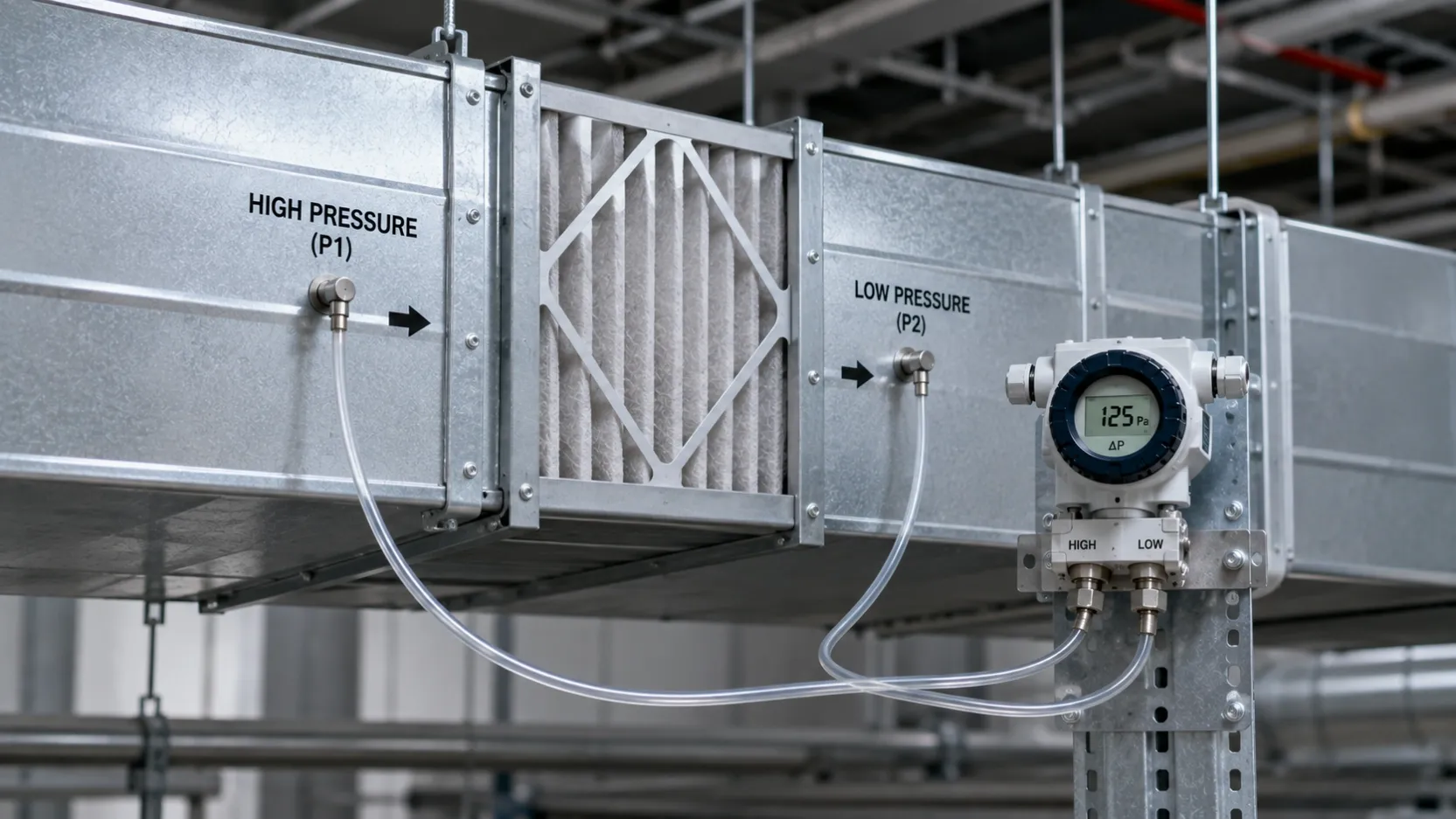
Low-pressure measurement uses a comparatively small pressure range, so mounting position, tubing, airflow, temperature change, vibration and reference conditions can form a larger part of the final uncertainty. Correct range selection and installation are therefore as important as the transmitter’s stated performance.
Define the pressure measurement
First determine whether the application requires gauge, absolute or differential pressure. Many ventilation, filter and clean-space applications use differential pressure between two locations. Small positive or negative gauge pressure may be used for room or enclosure monitoring.
State the reference clearly. A reading without a defined high side, low side or atmospheric reference can be interpreted incorrectly.
For a broader pressure transmitter selection workflow, see How to Select a Pressure Transmitter: A Practical Application Guide.
Establish the operating range
Record normal values, required resolution, alarm limits and expected startup or transient conditions. Select a range that provides useful resolution during normal operation without exposing the instrument to foreseeable overpressure.
Avoid choosing an unnecessarily wide range solely for protection. Overpressure capability and measurement range are separate specifications and should both be checked.
Review installation effects
Mounting position
Orientation can influence the zero point of some small-range instruments. Mount according to the model instructions and perform the applicable zero procedure after installation.
Pressure tubing
Tubing length, internal diameter, leaks, kinks, blockage, condensation and connection errors can affect the response. Route both sides of a differential system carefully and label the connections.
Temperature
Ambient changes can affect the sensor, electronics, tubing and the density of the measured gas. Use the model’s documented temperature performance and consider the complete installation.
Vibration and pulsation
Mechanical vibration or rapidly changing pressure may create an unstable signal. Review mounting, damping, sampling and the actual process dynamics rather than masking a problem with excessive filtering.
Typical applications
Low or differential pressure measurement may support:
- filter condition monitoring;
- duct and airflow-related control;
- clean-space or room-pressure monitoring;
- fan and blower systems;
- leak or pressure-decay testing;
- furnace, chamber or enclosure monitoring;
- gas-distribution and laboratory equipment.
Each application has different range, response, connection and safety requirements. A transmitter suitable for air-handling equipment is not automatically suitable for leak testing or a process gas.
Select the instrument and interface
Confirm:
- pressure type and range;
- allowable overpressure;
- medium compatibility;
- required uncertainty and response;
- mounting orientation;
- port and tubing arrangement;
- output, power supply and control-system input;
- display, zeroing or configuration needs;
- environmental and enclosure requirements;
- calibration and maintenance plan.
Communication, display and compensation functions vary by model. Verify the exact configuration rather than assuming a family-wide feature.
Commissioning and verification
Inspect tubing and connections, confirm high/low orientation and check control-system scaling. Perform zeroing only under the correct reference condition. Apply a suitable pressure reference across the required range when the application or site procedure requires it.
Document the model, range, units, mounting, tubing, configuration and baseline. When a reading changes, check the process, reference, tubing, installation and receiving system before concluding that the transmitter has drifted.
Practical questions
Why does a small mounting change affect the zero?
At a small measurement range, gravity and mechanical stress can be significant relative to the measured pressure. Follow the documented mounting and zero procedure.
Should the smallest possible range always be selected?
No. The range must cover normal operation and foreseeable excursions while providing the required resolution. Consider overpressure separately.
Can filter differential pressure directly predict remaining filter life?
Not by itself. It indicates resistance under the current airflow and conditions. Filter type, airflow, contamination and maintenance criteria must also be considered.
Is digital temperature compensation enough to remove thermal effects?
No. Documented compensation may address specified instrument behavior, but tubing, mounting, process gas and the rest of the measurement chain can still be affected.
Next step
Provide the pressure reference, normal and maximum conditions, medium, tubing arrangement, response, output and installation details. HRT can review available low-pressure or differential-pressure configurations. Final suitability must be confirmed for the exact model and application.