Aug 6, 2026Technical Guides
Compact Multi-Parameter Weather Stations for Industrial Environmental Monitoring
A practical guide to selecting and installing compact weather stations for localized industrial, utility and facility environmental monitoring.
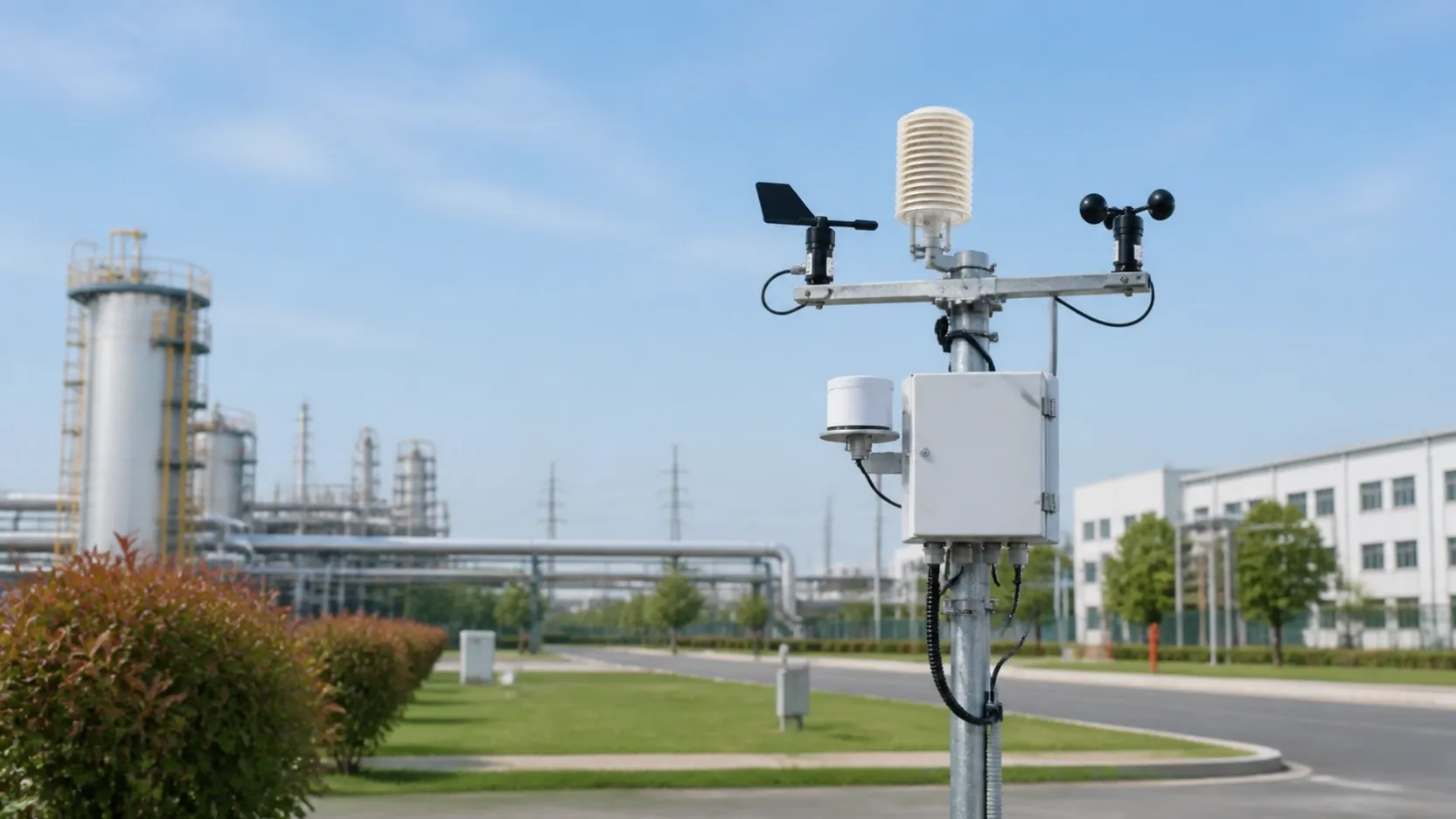
Environmental conditions can change significantly across an industrial site. A reading from a distant municipal weather station may not represent the temperature, humidity, wind or solar exposure around a process area, utility building, warehouse, ventilation intake or outdoor equipment enclosure. A compact multi-parameter weather station provides localized data that can be reviewed alongside equipment and process records.
What a Compact Station Can Monitor
A station can combine several sensing functions on one mast or mounting frame. The available configuration may include ambient temperature and relative humidity, illuminance or solar exposure, barometric pressure, carbon dioxide concentration, wind speed and wind direction. The exact sensor combination, measuring range, output and enclosure arrangement should be selected for the intended site rather than assumed from the appearance of the station.
Combining parameters creates useful context. Temperature and humidity help explain condensation risk and enclosure conditions. Illuminance data can support outdoor facility and greenhouse observations. Barometric pressure provides atmospheric context for local trends. CO2 monitoring can support ventilation assessment in occupied or semi-enclosed areas, while wind data helps interpret outdoor dispersion and air movement.
Typical Industrial and Facility Applications
Compact stations can support outdoor utility areas, water and wastewater facilities, industrial campuses, warehouses, building-management systems, agricultural facilities and remote infrastructure. They may also provide a local environmental reference for HVAC intake monitoring, equipment rooms or process areas where ambient conditions can influence measurements or maintenance decisions.
The station should be treated as part of a monitoring system rather than as an isolated device. Sensor outputs may be connected to a data logger, PLC, remote terminal unit, building-management platform or industrial IoT gateway. Communication method, power supply, sampling interval and data ownership should be confirmed before equipment selection.
Installation Conditions Matter
Mounting height and location can have as much influence on the result as the sensor itself. Temperature and humidity sensors need a suitable radiation shield and airflow. Wind sensors require clearance from walls, trees, exhaust outlets and structures that create turbulence. Illuminance sensors need an unobstructed field of view. A CO2 sensor must be positioned according to whether the objective is outdoor background monitoring, ventilation assessment or a specific local source.
Weatherproof enclosures, cable glands, grounding, surge protection and service access should be reviewed for the actual environment. Solar-powered installations also require an energy balance based on local sunlight, communications load and winter operating conditions. No single mounting arrangement is suitable for every application.
Information to Confirm Before Selection
Before requesting a quotation, prepare the required parameters, measuring ranges, output or communication protocol, power supply, installation location, enclosure needs, cable length and data-logging requirements. Also identify any project-specific certification, environmental or integration requirements. These details allow the station configuration to be reviewed against the real operating conditions.
A Practical Selection Approach
Start with the decision the data must support. Then select only the parameters needed for that decision, define a representative mounting location and confirm how the data will be collected and used. This application-first approach avoids unnecessary sensors while reducing the risk of collecting data that does not represent the actual site.
HRT Instrumentation can assist with requirement clarification and the selection of suitable environmental sensing configurations. Final product selection, installation and compliance should always be confirmed against the actual site conditions and project requirements.