
Aug 11, 2026Services & Support
On-Site Manufacturing Oversight for Technical Projects
A practical framework for defining inspection points, evidence and communication when a customer requires manufacturing oversight in China.
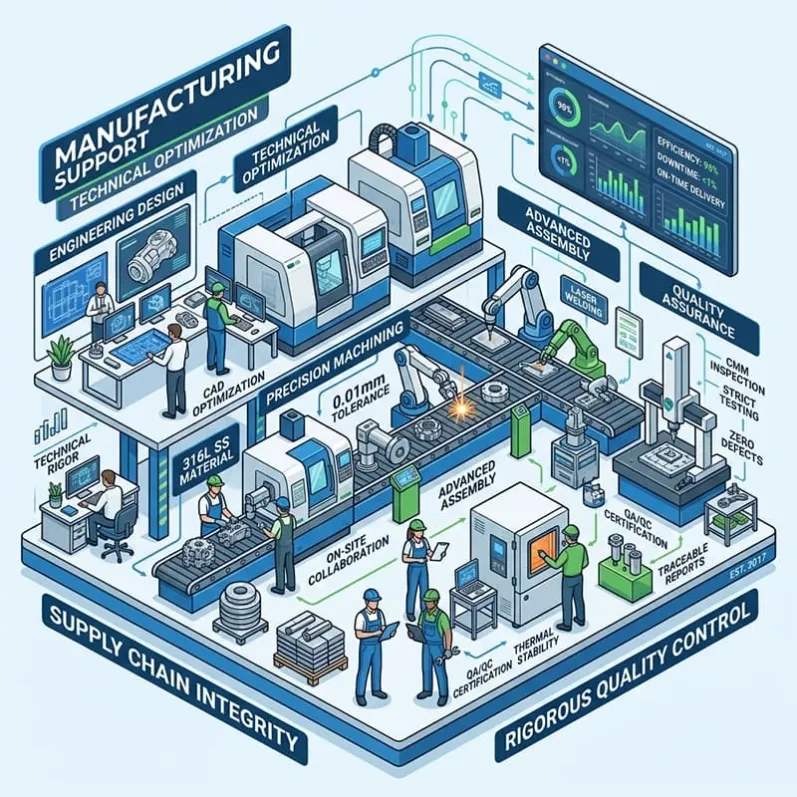
Direct answer
On-site manufacturing oversight can provide documented observations at agreed production or inspection stages. It does not guarantee product performance or replace the manufacturer’s quality system, contractual responsibilities or independent certification. The scope, acceptance criteria, access and reporting method must be agreed before work begins.
Define the oversight scope
Start with the product, drawing revision, specification, quantity, supplier location and project schedule. Identify which requirements can be observed or verified and which require laboratory tests, certificates or specialist inspection.
An oversight plan may include document review, incoming-material records, selected process observations, dimensional checks, assembly checks, test witnessing, packaging review or shipment-document review. The actual services depend on access, competence, equipment and the agreed contract.
Establish inspection and hold points
Define when work may proceed and when customer review is required. Hold points should be limited to requirements that materially affect the project and can be verified with available evidence.
For each point, state:
- requirement and drawing/specification reference;
- sampling or coverage;
- inspection or test method;
- equipment and calibration requirement;
- acceptance criteria;
- responsible party;
- record format;
- action for a nonconformity.
Control technical information
Use approved drawings, specifications and change records. Verbal instructions should be documented before they affect production. Revision status, authorized recipients and document retention should be agreed.
Confidentiality and intellectual-property protection require contractual and operational controls. Access should be limited to the information needed for the work. Do not claim that oversight alone prevents unauthorized use or disclosure.
Observe manufacturing and testing
Oversight may confirm that an agreed step was observed and record the available evidence. It should not state that an unobserved process was compliant. Critical or special processes may require qualified personnel, procedures and independent evidence beyond a general site visit.
Final inspection should use the approved criteria and an agreed sampling or coverage plan. Test results should identify the item, method, equipment and date. A passing sample does not prove every untested item is defect free.
Manage nonconformities
Record the requirement, observed condition, affected quantity and available evidence. The manufacturer should propose correction or disposition through the agreed process. Customer approval may be required for deviations or concessions.
Oversight personnel should not authorize design changes unless the contract explicitly assigns that authority. Maintain traceability between the issue, decision, rework and reinspection.
Reporting and communication
A useful report states what was reviewed, what was not reviewed, the applicable revision, evidence obtained, results, open items and next action. Photographs should be used only when permitted and should not expose unrelated confidential information.
Reports support decisions; they are not certificates unless issued under an applicable accredited or contractually defined scheme.
Practical questions
Does oversight guarantee that delivered goods will be fault free?
No. It can reduce information gaps and provide evidence at agreed points, but residual risk remains.
Can small batches or prototypes be supported?
Availability depends on location, scope, schedule, minimum commercial requirements and access. Confirm case by case before committing.
Can material grade be confirmed visually?
No. Review certificates, traceability and any agreed test method. Model-specific or batch-specific evidence may be required.
Who owns final acceptance?
The contract should identify the responsible party. An observer should not assume customer design authority or independent certification responsibility.
Next step
Provide the supplier location, product, drawings, specification, schedule, desired hold points and reporting requirements. HRT can review whether an appropriate oversight scope is available and identify limitations before quotation.