Aug 11, 2026Services & Support
Technical Supplier Sourcing and Evaluation in China
A structured approach to defining requirements, screening suppliers, verifying evidence and managing technical sourcing projects in China.
Direct answer
Technical sourcing should begin with a clear specification and evaluation plan, not a general assumption about a region, exhibition or supplier category. A sourcing partner may help identify candidates, collect information and coordinate reviews, but the customer should retain control of requirements, commercial decisions and final approval.
Define the requirement
Prepare the product or service description, drawings, standards, quantities, schedule, quality requirements, documentation, packaging, logistics and change-control expectations. Separate mandatory requirements from preferences.
Incomplete requirements make supplier comparisons unreliable. Clarify acceptable alternatives and who may approve a deviation before requesting quotations.
Build a candidate list
Candidates may come from existing networks, directories, referrals, exhibitions or direct research. The source of a lead does not prove capability. Record the legal entity, production location, product scope and contact information so similarly named firms are not confused.
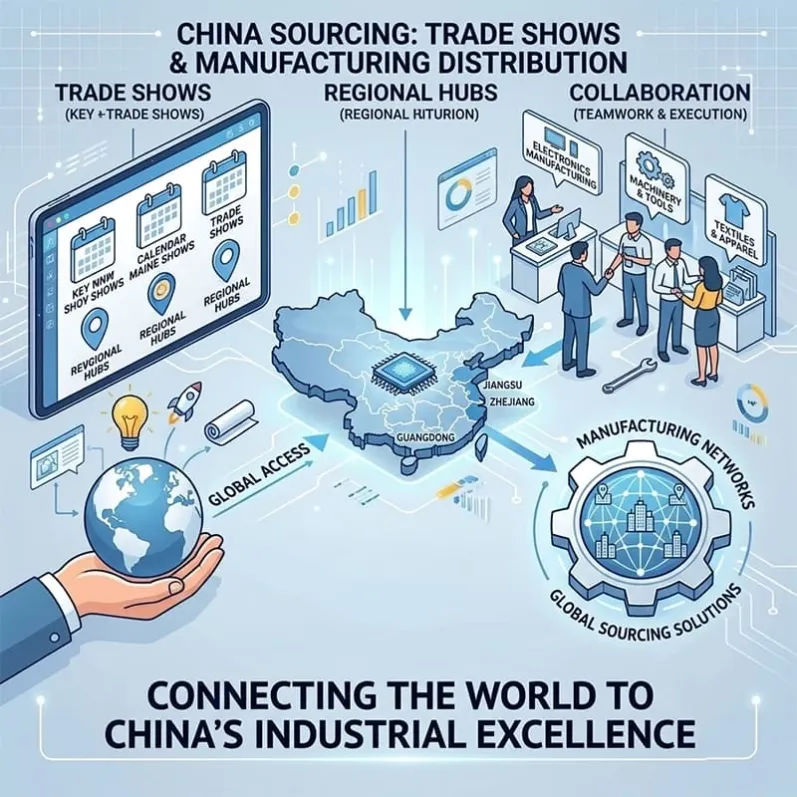
Regional manufacturing concentration may influence search efficiency, but broad cluster claims should not replace supplier-level evidence. Match each candidate to the actual requirement.
Screen documentary evidence
Request relevant capability information, drawings or examples, quality-system documents, equipment lists and references where appropriate. Check document ownership, dates, scope and consistency.
A certificate, brochure or exhibition display is not sufficient by itself. Verify that evidence applies to the legal entity, factory, process and product under evaluation.
Conduct technical evaluation
Use a comparison matrix with defined criteria such as:
- specification coverage;
- manufacturing and test capability;
- material and component traceability;
- drawing and change control;
- inspection and calibration records;
- subcontracted processes;
- capacity and schedule assumptions;
- communication and issue response;
- sample or pilot validation;
- commercial and logistics conditions.
Scores should be supported by evidence and accompanied by unresolved questions. Do not present a shortlist as “verified” unless the verification scope and limitations are documented.
Use site visits or third-party checks appropriately
A site visit can confirm observable conditions at a point in time. It may not establish long-term capacity, financial stability or compliance with every requirement. Define the visit scope, participants, evidence, photography rules and report format.
Special processes, certifications or regulated products may require qualified independent inspection or laboratory evidence. General sourcing support should not be represented as accredited certification.
Validate before scaling
Use drawings, samples, first articles or a pilot batch when appropriate. Define acceptance criteria and record deviations. Do not treat a successful sample as proof that future production will remain unchanged without process and change controls.
Commercial terms should address specification, revision, inspection, nonconformity, change notification, intellectual property, delivery and dispute handling. Obtain qualified legal advice where needed.
Practical questions
Do trade fairs identify the best supplier?
They can produce leads, but capability must be evaluated after the event against the actual requirement.
Can a sourcing partner guarantee supplier performance?
No. Structured evaluation can reduce uncertainty, but the supplier, contract, process and customer controls determine the outcome.
How should price be compared?
Compare equivalent specification, quantity, documentation, testing, packaging, delivery and commercial terms. A lower quoted price may reflect a different scope.
What should a field report include?
Scope, date, location, participants, applicable requirements, observed evidence, limitations, findings, open questions and recommended next steps.
Next step
Provide the specification, quantity, schedule, quality requirements and desired sourcing/verification scope. HRT can review available support activities and identify what requires supplier, independent inspector or customer approval.